


FLIGHT OR AERIAL ADAPTATION OF BIRDS
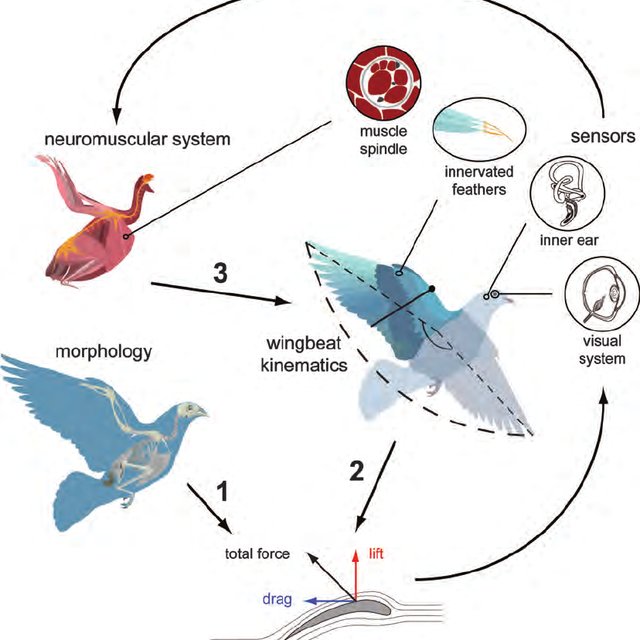
Birds are the only amniotes whose bodies are highly specialized for aerial mode of life.
Besides aerial mode of life, most birds are also well-adapted for terrestrial mode of life.
However, during their evolutionary course, a marked adaptive radiation has occurred in them, as certain birds either became exclusively terre. strial and flightless (e.g., ostrich, kiwi, etc.), or certain other birds became well adapted for aquatic as well as terrestrial mode of life (e.g., ducks).
Here we are mainly concerned with aerial or volant adaptations of birds, therefore, we will describe them in detail.
Most present-day aerial birds are "heavierthan-air" machines and almost every part of their organization has been modified for aerial life.
To fly in air, they have to possess following essential specializations in their morphology, anatomy and physiology:
(i) Organs for flight,
(ii) Lightness and rigidity,
(iii) Evolution of extra energy with provision for high power,
(iv) Speed and
(v) Balancing and control.
All these requisites for volant life of birds can be studied under the following headings:
X X
A. Morphological Volant Adaptations
Most birds possess following important flight or volant adaptations:
1. Body contour:
Because speed is a must for aerial life, so, to minimise the resistance offered by air during flight, the body of most birds is fusiform or spindle-shaped and it lacks any extra projection which may offer resistance in the attainment of speed in air.
Further, the attachment of wings high upon the thorax, the high position of light organs like lungs and sacs, and low position of heavy muscles, sternum and digestive organs and consequently low centre of gravity are other morphological facts of great significance.
2. Body-covering of feathers:
Body of all birds is covered by special integumentary derivatives called feathers.
Feathers are diagnostic of birds since no other group of animal kingdom has ever developed them.
Feathers have following advantages for birds:
(a) The smooth closely fitting and backwardly directed con- tour feathers make the body stream-lined and reduces the friction to the minimum.
(b) The feathery covering makes the body light and at the same time protects from the hazards of environmental temperature.
(c) The feathers hold a considerable blanket of enveloping air around the body and add much to its buoyancy.
(d) The non-conducting covering of feathers insulates the body perfectly and prevents loss of heat which enables the bird to endure intense cold at high altitudes and also to maintain a constant temperature.
(e) Feathers of wings form a broad surface for striking the air.
3. Organs for flight:
The forelimbs have transformed into unique and powerful propelling organs, the wings. The wings are the sole organs of flight.
These organs have complicated structural constructions consisting of a framework of bones, muscles, nerves, blood vessels, feathers, etc. Both wings spring from the anterior region of trunk.
During rest they remain folded against the sides of the body, but during flight they become ex- panded.
The surface area of the wings is increased by the develop- ment of elongated flight-feathers, the remiges.
The vane of each remix forms a flexible and continuous surface for striking the air in flight.
The flight feathers of a wing also form a bread surface for supporting the bird in air.
The particular shape of the wing, with thick strong leading edge, convex upper surface and concave lower surface, causes reduction in air pressure above and increase below with minimum turbulence behind.
This helps in driving the bird forwards and upwards during flight.
4. Mobile neck and beak:
The transformation of fore- limbs into wings is duly compensated by the extreme mobility of the long and flexible neck for reaching food.
The mouth is drawn out into a horny beak which acts as a pair of forceps in picking up the things and in various other activities such as nest building, pruning, etc., which are normally done by forelimbs in other animals.
5. Bipedal locomotion:
As anterior part of the body of birds becomes concerned with flight, the posterior part of body becomes modified for movement on land.
For locomotion on the ground and to support the entire body weight, the hindlimbs occupy a somewhat anterior position on the trunk and become more stouter.
6. Perching:
The hindlimbs of a bird are well specialized for an arboreal life.
Their muscles are developed in such a manner that when a bird sits on a branch of the tree, the toes close round the twig automatically.
This happens due to so called perching mechanism, when the bird settles on the branch of a tree, the legs are bent and puts the flexor tendons on the stretch.
With the exer- tion of the pull, the toes are bent spontaneously around the perch.
A bird can go to sleep in this position without any fear of falling off.
7. Short tail:
The short tail of a bird bears a tuft of long tail feathers or rectrices, which spread out in a fan-like manner and serve as a rudder during flight.
They also assist in steering, lifting and counter-balancing during flying and perching.
X X
B. Anatomical Volant Adaptations:
Flying birds have following anatomical modifications for volant life:
1. Flight muscles:
The action of the wings are controlled by the flight muscles which are greatly developed, while the muscles of the back remain greatly reduced.
The muscle fibres comprising the flight muscles are long and striated to withstand fatigueness after prolonged activity.
The important flight muscles are
1. Pectoralis major:
The powerful down stroke of the wings is caused by this immense muscle.
2. Pectoralis minor:
The raising or elevation of the wing is caused by this muscle.
3. Coraco brachialis muscles:
These small muscles aid in depressing the wing.
4. Tensors patagialis muscles:
It help to keep the patagia tensely stretched when the wings are extended.
The flight muscles are highly vascularized structures.
The subclavian artery is very stout and divides into two branches: a pectoral artery to supply the flight muscles and an axillary artery to the wing.
3. Lightness and rigidity of endoskeleton:
The skele- tal framework of flying birds is very stout and is lightly built on the "hollow-girder principle".
It has attained mechanical perfection by using all possible architectural principles to get maximum strength and rigidity.
Most of the bones are pneu- matics, filled with air spaces and provided with a secondary plastering to make them rigid.
Many bones are either rod-like or T-shaped.
Further skeletal framework becomes compact, centra lized, rigid due to fusion of bones.
Endoskeleton of birds thus contains the following characteristics:
(i) The skull bones are paper-like thin and show a tend- ency towards the reduction in their number.
These bones are firmly fused with each other. skull is spongy. lighter beak.
The posterior portion of the Teeth are lacking, being replaced by a much
(ii) All the thoracic vertebrae except the last are fused into a single mass.
The rigidity of the dorsal part of vertebral column due to fusion of vertebrae, provides a firm fulcrum for the action of wings in striking air, while the arched clavicles and powerful pillar-like coracoids of pectoral girdle are well suited to resist the inward pressure of the down-stroke.
(iii) The heterocoelous vertebrae confer great flexibility and all birds can move their neck through 180° which help in pruning feathers in all parts of the body.
(iv) The shortening of caudal vertebrae and formation of pygostyle has assisted stability in air.
(v) The uncinate processes of thoracic ribs help in providing compactness, necessary for flight by concentrating the mass.
(vi) Sternum or breast bone like a T-shaped girder, supports the abdominal viscera.
It contains a median ridge or keel for the attachment of major flight muscles in flying birds, while it is with- out a keel in running birds, like ostrich.
(vii) The fusion of the pelvis with synsacram (viz., fused mass of last thoracic vertebra + all lumber vertebra + all sacral verte. brae + few caudal vertebrae) not only supports the weight of the body when the bird is walking, but also counteracts the effect of shocks as the bird alights.
The absence of a ventral symphysis permits laying of large eggs..
(viii) The fusion of distal tarsals with the metatarsals to form a tarsometatarsus, and that of proximal tarsals with the lower end of tibia to form a tibiotarsus, help to strengthen the legs for bipedal gait.
(ix) The skeleton of fore limbs is completely modified. There are only three digits, which are more or less fused.
X X
3. Digestive system:
The rate of metabolism in birds is very high, food requirements are great and digestion is rapid.
Most birds are very selective in their diet and accordingly their beaks are variously modified.
Further, because undigested waste is minimum and is immediately got rid off, consequently the rectum becomes much reduced in length and never stores the undigested food.
The ill-development of rectum of flying birds indicates towards the fact that the flying animals cannot afford to bear the weight of faeces.
The absence of gall bladder in birds minimize the body weight to some extent.
4. Respiratory system:
As a flying bird requires great and sustained power, therefore, its respiratory system remains specia- lized in such a fashion that the food is combusted (oxidized) rapidly and completely to liberate large amount of energy.
To meet the extensive rate of metabolism greater amount of oxygen molecules is needed by the body tissues.
For this purpose, the dense, inelastic and complicated lungs are supplemented by a remarkable system of air sacs, which grow out from lungs and occupy all available space between internal organs, even extending to the cavities of hollow bones.
The air sacs primarily reduce the speci- fic gravity of the bird and also facilitate complete aeration of the lungs.
The avian lungs are aerated twice at each breath which secures perfect oxygenation of blood.
The air-sacs help in regul- ating body temperature by internal perspiration.
Further, inser- tion of air-sacs in between the flight muscles like pads reduces mechanical friction and increases the mobility in muscular action.
5. Circulatory system:
Rapid metabolism requires large oxygen supply to the tissues, which can be achieved by an efficient circulatory system.
Accordingly, avian heart is large-sized, powerful and efficient.
Due to double circulation in it, the oxy- genated and deoxygenated bloods completely separated.
Further, red blood cells of birds contains large amount of haemo- globin and this is responsible for blood's quick and perfect aeration.
6. Warm-bloodedness:
Due to perfect aeration of blood, the body temperature remains high (40°-46°C) and does not change with the change of environmental temperature.
For this reason birds are called warm-blooded or homeothermal animals.
The high and constant body temperature enables the bird to take flights at high altitudes and also facilitates activeness in every season.
7. Excretory systems:
The avian excretory system be. comes specialized in three ways:
1. For the retention of water, the uriniferous tubules of avian metanephric kidneys are added with Henle's loops, which are efficient in water absorption.
The coprodaeum of cloaca is another efficient water absorbing organ of birds.
2. For reducing the weight of body, there occurs no urinary bladder and the semi-solid urine is immediately excreted out, not retained for long in the body.
3. The metabolic nitro- genous wastes are converted into less toxic and insoluble organic compounds such as uric acid and urates, which is an important physiological volant adaptation.
8. Brain and sense organs:
The avian brain is highly developed consisting of well-developed centres of equilibrium, muscular coordination and instinct.
Hence, the cerebellum and cerebrum are highly developed.
Further, because birds have to depend mostly on the sense of sight, so, the eyes and optic lobes of brain are well developed.
The ill-development of olfactory or smelling organs reflects in ill-development of olfactory lobes of brain.
9. Reproductive organs:
In female birds the ovary and oviduct of one side (ie., right side) of body are preserved.
This necessarily reduces the weight of body.
Thus, it becomes evident that birds are fully developed for terrestrial, arboreal and aerial environments.

Fig. 1.Diagram showing the streamlined body of bird.
View, Comments and share..........


0 Comments